Whether you know absolutely nothing about Martial Law, or only know about Martial Law through social media posts, or even if you've already learned about Martial Law in school, this resource CARRD is for you. Here you can learn about our history and help defend it from distortion.
Ways you can help 👇
☝️ Educate Yourself
Learn: What happened during Martial Law?
Unlearn: What didn't happen during Martial Law?
Remember: Who are the victims of Martial Law?
✌️ Act!
Online: Share this CARRD!
Online: Subscribe to and Share fact-checked reports
Online: Report False Information to Fact-Checkers
Online: Become a Fact-Checker
Offline: Teach Martial Law Correctly
Offline: Volunteer for On-Ground Events about Martial Law
Offline: Volunteer for Dedicated Truth-Tellers
Online: Donate to Dedicated Truth-Tellers
Offline: Join Youth Collectives
This CARRD was compiled and fact-checked by our team of student volunteers at the 1081 Exhibit, an academic and not-for-profit awareness campaign in Cebu dedicated to fighting historical distortion about Martial Law.
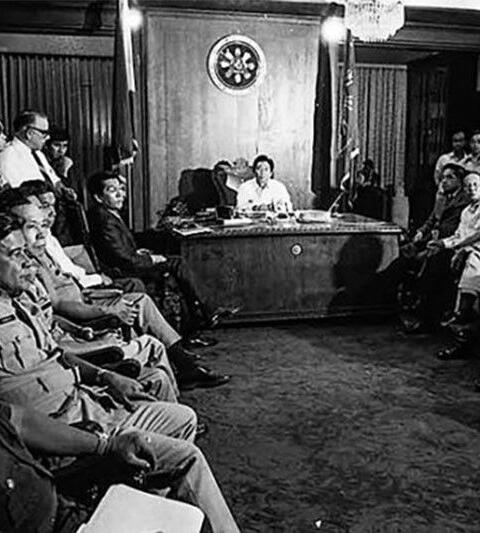
January 23, 1970
Days of Disquiet, Nights of Rage
Under Ferdinand Marcos’ first term, the Philippines was plagued with poverty. It was under his term in the early 1960s that the Philippines experienced a disappointing economic performance: increasing government debt, high inflation, and unemployment. Such economic depression encouraged civilians to air their strife—some of these protests resulted in violent dispersals.Despite the country’s ordeal, by the end of 1969, the majority of Filipinos still continued believing in Marcos’ capability that he won the November 11, 1969 elections. This granted him his second term and was supposedly his last in accordance with the 1935 Philippine Constitution. Although the majority has gained him the privileged powers vested in him, it is undeniable that the country’s poverty and the ballooning debt caused by his administration did not leave the people’s scrutinyThis caused days of disquiet and nights of rage from as early as January 1970 until March. There has been a series of protests held at Plaza Miranda, the US Embassy, Mendiola, and Sunken Garden. One of which was the protest on January 23 attended by 50,000 protesters after he delivered his fifth State of the Nation Address (SONA) in the National Museum of Fine Arts–the then legislative building. But the most remarkable and most violent protest was the Battle of Mendiola on January 30, 1970, that which lasted until 5 pm.The cry of the protesters as they marched towards their rendezvous was: “Makibaka! Huwag matakot!”This series of protests is not only attended by progressive organizations, but also students, student farmers, laborers, and urban groups to the point that Enrique Sta. Brigida, a student of Lyceum of the Philippines, was caught and tortured to death by the police because of his participation in these rallies.Sources:
[1] https://martiallawmuseum.ph/interactive/warningsigns/
[2] https://upd.edu.ph/wp-content/uploads/2021/10/UPDate-Vol4-Num1-12-First-Quarter-Storm-Timeline.pdf.
[3] https://www.rappler.com/nation/251141-first-quarter-storm-1970-revisited/.
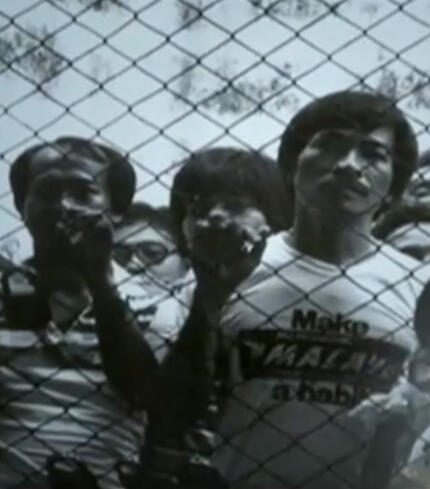
August 21, 1971
Suspension of the Writ of Habeas Corpus
As the Liberal Party conducted its proclamation rally at Plaza Miranda on August 21, 1971, two hand grenades were thrown onto the stage by an unidentified person. Such a disaster cost nine lives and injured around a hundred attendees including politician Jovito Salonga who was onstage.After the catastrophic bombing encounter at Plaza Miranda, Marcos suspended the privilege of the writ of habeas corpus to stifle the communist insurgency as he firmly believed the bombing was executed by the communist party CPP-NPA. The suspension of the writ of habeas corpus allows arrest even without any proof of arrest warrants; this helps to easily catch the enemies of the country: the communists.“I, President Marcos, President of the Philippines by virtue the powers vested upon me by article 7, section 10, paragraph 2 of the constitution do hereby suspend the privilege of writ of habeas corpus.”The suspension of the writ of the habeas corpus was considered the prelude to what would come the following year.Sources:
https://martiallawmuseum.ph/interactive/warningsigns/
https://vimeo.com/314920652